

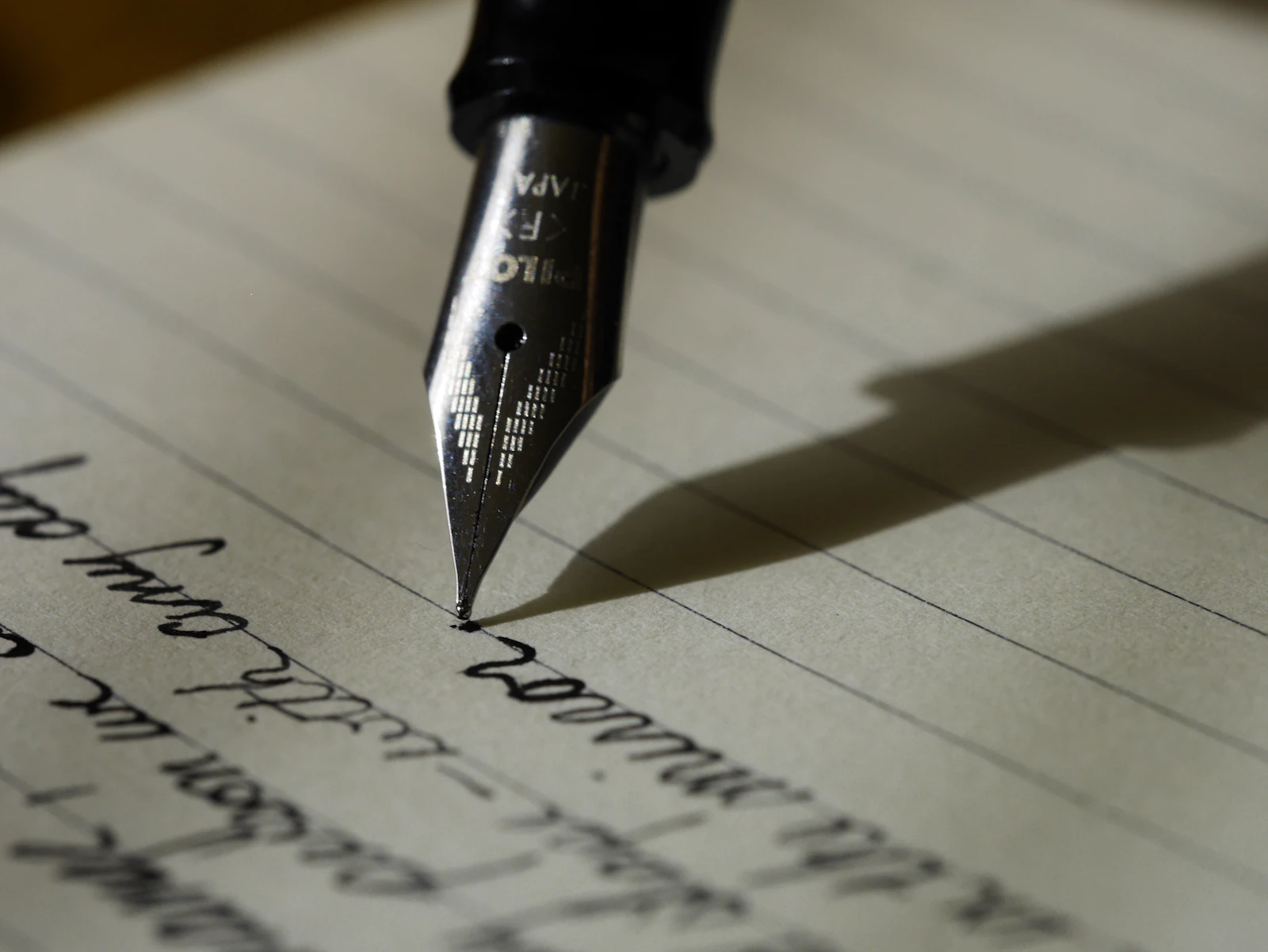
Every writer worries about the same thing when they hand their story to someone else: will it still sound like me? It's the right worry. Voice is the thing readers fall in love with long before they can articulate why, and it's the first thing to flatten in the rush to be correct, polished, and professional. A manuscript can be grammatically immaculate and still feel like it was written by nobody in particular.
What Voice Actually Is
So let's be precise about what voice actually is, because the word gets used loosely. Voice is not vocabulary, and it's not a signature word you sprinkle in. It's the sum of a hundred small habits: your rhythm, the length of your sentences, the jokes you can't help making, the things you notice that other people walk past. It lives in what you leave unsaid, in whether you trust the reader to keep up or hold their hand through every turn. None of that shows up in a style guide, which is exactly why style guides can't teach it to you.
The most common reason a writer loses their voice is a good one gone wrong: the desire to sound like a Real Author. You read the books you admire, you absorb their cadence, and without noticing you start writing in a borrowed register — more formal, more distant, more careful than you actually are. The tell is usually a stiffness in the first few pages, a throat-clearing quality, sentences that would never survive being spoken out loud. Your true voice is almost always warmer and more direct than the one you reach for when you're trying to impress.
Finding Your Baseline Register
Here's a practical starting point. Find three pieces of your own writing that were never meant to be published — a long text to a close friend, an angry email you didn't send, a story you told in a group chat that made people laugh. Read them back and notice what they have in common. That's your baseline register: the way you sound when you've forgotten anyone is watching. The goal of finding your author's voice isn't inventing something new, it's giving that unguarded self permission to show up on the page.
Reading your work aloud is the single most useful habit we can recommend, and almost nobody does it consistently. Your ear catches what your eye forgives. The sentences you stumble over, the ones where you run out of breath or trip on a clause, are usually the ones that aren't yet yours — they're too tangled, too abstract, or borrowed from someone else. If you can't say it comfortably, a reader can't hear it comfortably either.
Specificity and Shifting Tone
Voice also depends on specificity, and this is where a lot of otherwise capable writing goes gray. Generic detail produces generic voice. 'She was upset' could have been written by anyone; 'she kept refilling a mug of coffee she had no intention of drinking' could only have been written by someone who was actually there, watching. The particular observation — the exact object, the specific gesture, the detail only you would have noticed — is where personality lives. When your prose feels flat, the fix is usually not a better adjective but a truer detail.
It helps to know that voice is contextual, not fixed. The voice you use for a tense confrontation should not be the voice you use for a tender memory, and a book that reads in a single unbroken tone starts to feel airless. Think of it less like a costume you put on and more like your actual speaking voice, which naturally speeds up when you're excited, goes quiet when something matters, and gets clipped when you're angry. Consistency of voice doesn't mean sameness of tone — it means the variations still sound like they belong to one person.
How We Capture Your Voice
When we ghostwrite for an author, capturing voice is the whole job, so we treat it as a discipline rather than a hope. We start by listening: hours of interviews, yes, but also the offhand phrases, the way you build to a punchline, the words you reach for when you're relaxed versus when you're being careful. From that we build a working voice profile — favorite sentence shapes, characteristic transitions, the humor register, the things you'd never say — and we test it early. The first chapter is a checkpoint, not a commitment. You read it, you flag every sentence that sounds like a stranger, and we recalibrate before writing another word.
By the time we're a few chapters in, something reassuring tends to happen: authors stop being able to tell which sentences were originally theirs and which we drafted. That's the target. It means the voice on the page has become a faithful amplification of the author rather than an imitation of them. If you're writing solo, you can run the same loop yourself — draft a chapter, set it aside for a week, then read it cold and mark everything that doesn't sound like you. The distance is what lets you hear it.
Protecting Voice in Editing
A word of caution about editing, because this is where hard-won voice is most often sanded off. A good editor should sharpen your voice, never neutralize it. If feedback consistently pushes you toward the blandly correct — smoothing your fragments, cutting your asides, replacing your odd perfect word with a safer one — something has gone wrong. The best editorial relationships protect the strangeness that makes you you while fixing the things that genuinely trip a reader up. Learn to tell the difference between 'this is unclear' and 'this is unusual,' because only the first is a problem.
None of this happens on the first draft, and it shouldn't. First drafts are for getting the story down, not for sounding like yourself — voice usually emerges in revision, once you're no longer white-knuckling the plot. Give yourself permission to write badly early, then use the passes that follow to lean into the phrasings that feel most alive and cut the ones that feel performed. Voice is a subtraction as much as an addition: often you find it by removing everything that isn't you.
The Takeaway
The takeaway is simple, even if the practice takes years. Your voice is not something you have to manufacture; it's something you already own and mostly have to stop hiding. Read aloud, chase the specific detail, trust the way you actually talk, and defend the quirks that a nervous first draft wants to erase. Do that consistently and the book will sound like you — which is the only thing that will ever make it sound like no one else.
Your book could be next.
Talk to a publishing advisor today — a free, no-obligation consultation and quote.
Book a free call
